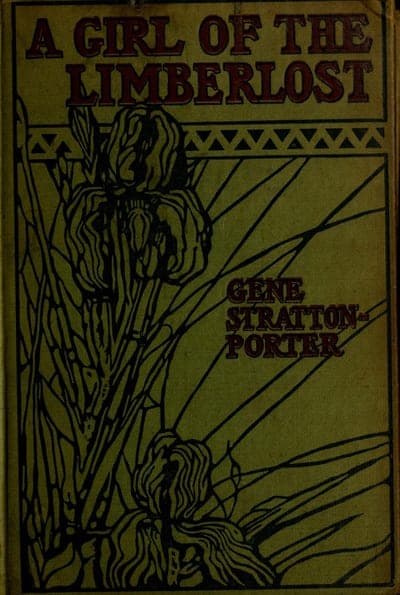
- First published
- 1909
- Author
- Gene Stratton-Porter
- Publisher
- Doubleday, Page & Company
- Pages
- 485
- This copy
- An early Doubleday, Page & Company printing (the iris-cover cloth design used on its original and near-original printings)
A Girl of the Limberlost
Gene Stratton-Porter · 1909
Elnora Comstock walks into the high school at Onabasha in a calico dress and heavy farm shoes and learns two things in the first hour: the city does not furnish books, and students from outside town pay tuition. She has neither. Her mother has money and will not spend it. Robert Comstock drowned in the swamp quicksand on the night Elnora was born, and Katharine has spent her daughter's whole life holding her responsible for it.
The swamp pays the bill. Elnora collects moths and Indian artifacts out of the Limberlost and sells them — the moths to the Bird Woman, a naturalist assembling a book on American moths, the stone points to a banker. The first transaction comes to fifty-nine dollars and sixteen cents, which covers the books and the tuition; the shoes and the dress have to wait for the next sale. The collection she starts from is a specimen case Freckles left behind in the swamp in Stratton-Porter's earlier novel. Wesley and Margaret Sinton next door do the mothering Katharine refuses. Stratton-Porter worked as a field naturalist, and the moth-hunting is written from the inside: species, seasons, what it takes to get one out of the swamp undamaged.
Half the book is an accounting problem solved item by item, and that half is why it survives. The other half is Philip Ammon, in the country to recover from typhoid, and his engagement to the wealthy Edith Carr, and the courtship runs on much softer machinery. Edith reforms, everyone pairs off, and the reconciliation between mother and daughter turns on a violin. The nature writing stops the story cold at intervals. For a reader who wants a competence story, the first half is unbeatable.