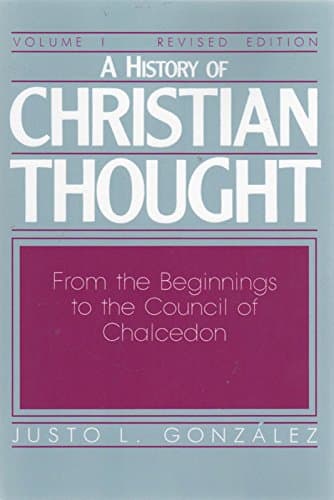
- First published
- 1970
- Author
- Justo L. González
- Publisher
- Abingdon Press
- Pages
- 426
- This copy
- Abingdon Press, Volume I, Revised Edition
A History of Christian Thought
Justo L. González · 1970
Three volumes, not one, and each has its own ground. The first runs from the cradle of Christianity to the Council of Chalcedon. The second picks up at Augustine and stops on the eve of the Reformation. The third carries from the Reformation into the twentieth century. González is following arguments rather than events — what Christians worked out that they believed, and the quarrels by which they worked it out.
The unit of organisation is the controversy. The Arian dispute gets two chapters, one before Nicaea and one after, because the interesting part is what happened once there was a creed and the argument went on anyway. Alexandria gets a chapter to itself for Clement and Origen. The Nestorian quarrel gets one, the Council of Ephesus with it, then Chalcedon. What is unusual for a survey of this vintage is that the Eastern church never becomes an appendix: there are standing chapters on Eastern theology after Origen, between the fourth and sixth councils, from the Islamic conquests to the Fourth Crusade, and on to the fall of Constantinople.
This is a seminary text and reads like one, though González will close a volume with a verdict rather than a summary — volume one ends on "Apostolic or apostate?", volume two on "Dawn or dusk?". The reservation is that it is doctrine all the way down. Persecutions, missions and personalities show up only where they moved an argument, and there is a lot of following someone else's reasoning about the relation of two natures. Anyone who wants the story of the church rather than the history of its thinking is better served by González's own Story of Christianity.