- First published
- 2005
- Author
- W. Chan Kim and Renée Mauborgne
- Publisher
- Harvard Business School Press
- Pages
- 240
- This copy
- Harvard Business School Press, 2005
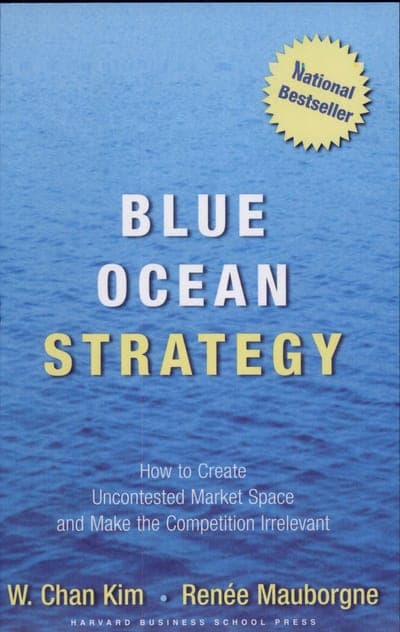
Blue Ocean Strategy
How to Create Uncontested Market Space and Make the Competition Irrelevant
W. Chan Kim and Renée Mauborgne · 2005
Kim and Mauborgne call the market most businesses fight in a red ocean — a known industry, known rivals, the same customers carved thinner until the water turns bloody — and set against it the blue ocean, market space nobody has defined yet. Their flagship case is Cirque du Soleil, which never tried to out-circus Ringling Bros. It cut the animal acts and the star performers, two of the costliest things a circus buys, dropped aisle concessions and multiple rings, kept the clowns but moved their humour away from slapstick, added a theatrical through-line, and charged several times the price of a circus ticket to adults and corporate clients who had been going to the theatre instead.
The tools are the Eliminate-Reduce-Raise-Create grid and the strategy canvas, which charts an industry's competing factors so a company can see which ones it competes on out of habit rather than customer demand. The clearest example outside entertainment is Yellow Tail, the Australian wine that broke into America not by out-competing the premium and budget wines already on the shelf but by dropping the vocabulary of tannins and oak and selling just two approachable bottles alongside beer and cocktails — taking out cost and complexity at the moment competitors were adding both, which is what the authors mean by value innovation.
It is written for the strategist already convinced that competing harder inside a shrinking margin is a losing game. The honest reservation is the one levelled at books that work backward from big wins: the framework is reconstructed after the fact from Cirque du Soleil and Yellow Tail, and there is little here about the companies that ran the same grid and found a blue ocean that was empty for a reason.