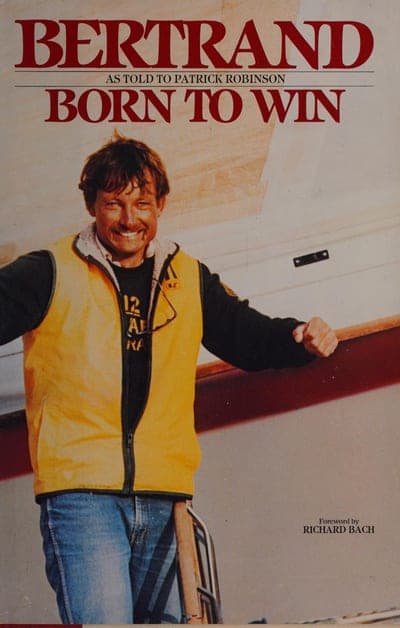
- First published
- 1985
- Author
- John Bertrand, as told to Patrick Robinson
- Publisher
- Hearst Marine Books
- This copy
- Hearst Marine Books, New York, 1985 first edition — matched by title, author and cover design to the archive.org record for this printing, though no publisher mark is actually legible on the jacket photograph itself.
Born to Win
A Lifelong Struggle to Capture the America's Cup
John Bertrand, as told to Patrick Robinson · 1985
September 1983, off Newport, and the Australian challenger is down three races to one. No challenger had taken the America's Cup in the 132 years since the schooner America won it around the Isle of Wight, and the New York Yacht Club had never had to hand it over. John Bertrand steered Australia II in that series and wrote this account two years afterwards with Patrick Robinson; the subtitle, a lifelong struggle to capture the America's Cup, is honest about how far back it starts.
Two things did it. One was Ben Lexcen's winged keel, which the New York Yacht Club tried to have ruled out on two grounds at once — that it broke the twelve-metre rule, and that Dutch engineers rather than Lexcen had designed it. It was ruled legal. The other was preparation of a kind yacht racing had not much bothered with: Bertrand's side worked the mental half deliberately, and would not speak Dennis Conner's name, referring to Liberty only as the red boat. Australia II then won the fifth, sixth and seventh races, the last by forty-one seconds after a tacking duel of nearly fifty tacks.
It suits anyone who likes a campaign told from inside by the person who ran it, and it is unusually good on the hardware: Bertrand trained as an engineer and took a master's at MIT, and the boat is a problem to solve rather than an object to admire. The reservation is the obvious one: this is the winner's version, written while it was still warm, and generous to his own side. The racing chapters also assume you want the tactics, and if covering and lay lines mean nothing to you, stretches of it will pass in a blur.