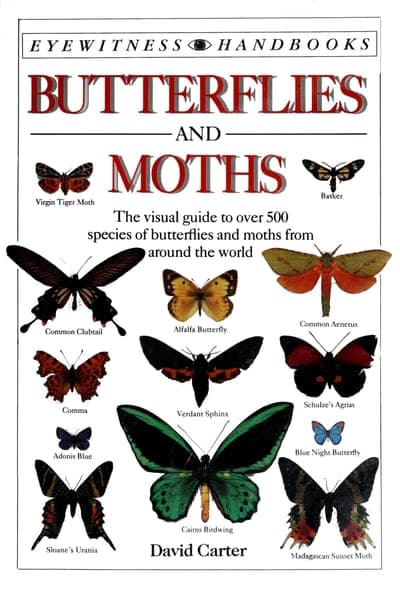
- First published
- 1992
- Author
- David Carter
- Publisher
- Dorling Kindersley
- Pages
- 304
- This copy
- Dorling Kindersley, Eyewitness Handbooks series, 1992
Butterflies and Moths
The Visual Guide to Over 500 Species of Butterflies and Moths from Around the World
David Carter · 1992
Every page in this book has the same shape. Across the top, the family and the species — Family Hesperiidae, Species Urbanus proteus — then the common name, long-tailed skipper. Below that a photograph with hairline leaders running out to the things that identify it: the extended hindwing tails, the curved tips of the antennae. Then Early Stages, describing the caterpillar and what it feeds on, olive-green with brown lines, living on cultivated beans. Then Distribution. A coloured band across the foot gives time of flight, habitat and wingspan.
Finding that page is the other half of the design. The introduction divides the world into zoogeographical regions, and each region gets a plate of its species arranged together with names attached, so a reader who knows nothing except where they are standing can pick out a shape and work down to the entry. There are more than five hundred species and roughly six hundred photographs, with Frank Greenaway on the camera and John Still drawing the caterpillars. In front of it all sit short sections on life cycle, survival, conservation, rearing, and planting a garden that will bring them in.
It suits someone who wants to know what a thing is without working through a dichotomous key. The reservation is one Carter states himself: he could not cover the Microlepidoptera, so the clothes moth and the codling moth are named in the introduction and then simply left out, along with thousands of other small species. And it is a world sampler rather than a local field guide — the selection was made to show the range of the order, which means the moth on one particular porch in one particular county may not be in it.