- First published
- 2002
- Author
- Kerry Patterson, Joseph Grenny, Ron McMillan, and Al Switzler
- Publisher
- McGraw-Hill
- Pages
- 240
- This copy
- McGraw-Hill, 2002 (first edition)
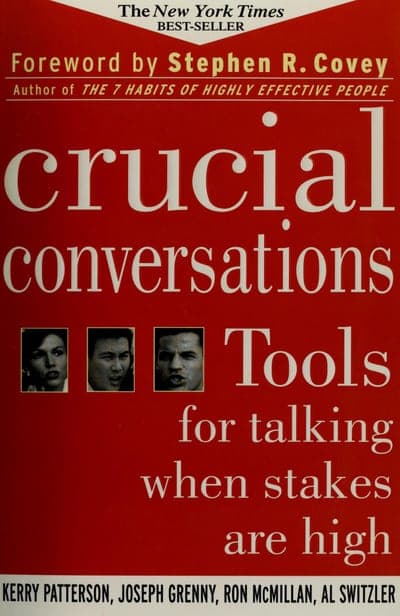
Crucial Conversations
Tools for Talking When Stakes Are High
Kerry Patterson, Joseph Grenny, Ron McMillan, and Al Switzler · 2002
The book gives its subject a specific definition before it offers any advice: a crucial conversation is one where the stakes are high, opinions differ, and emotions are running strong — a salary negotiation, a confrontation with a partner, telling a coworker their work isn't good enough. Patterson and his co-authors argue most people handle exactly this kind of conversation worst, defaulting to silence (going quiet, deflecting, withdrawing) or violence (interrupting, controlling, attacking) the moment it gets uncomfortable.
Their fix is a named sequence: STATE — share the facts first, tell the story you're drawing from those facts, ask for the other person's view, talk tentatively rather than as if your conclusion is certain, and encourage the other person to test what you've said. Underneath it sits the idea of a 'pool of shared meaning' — the combined facts and opinions both people are willing to put on the table — with the claim that the size of that pool, not who wins the exchange, is what predicts a good outcome.
It comes out of a corporate-training practice — several authors, a company built around teaching this material to organizations — and it reads like one: the acronyms and the recurring cast of workplace scenarios are built for a seminar handout, not for literary pleasure. Anyone allergic to that format will feel it by the third chapter; the content underneath holds up regardless.