- First published
- 2013
- Author
- Chip Heath and Dan Heath
- Publisher
- Crown Business
- Pages
- 336
- This copy
- Crown Business, 2013
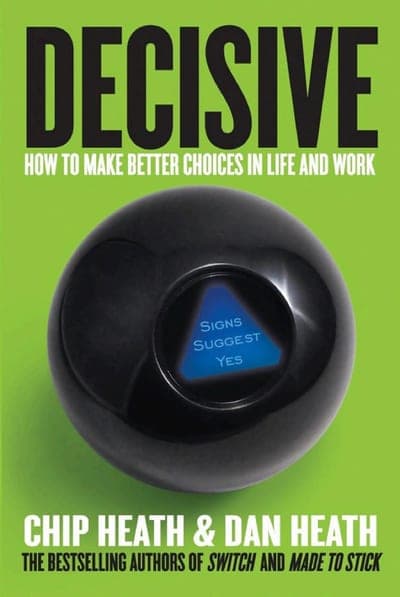
Decisive
How to Make Better Choices in Life and Work
Chip Heath and Dan Heath · 2013
The Heaths open Decisive with the same diagnosis that runs through their other books: normal decision-making is a narrow frame, a quick pro-and-con list, a choice made on gut feeling and rationalized after the fact. Against it they build a four-step process, WRAP, meant to interrupt each failure point in turn — Widen your options, Reality-test your assumptions, Attain distance before deciding, and Prepare to be wrong.
Each letter comes with a named tool rather than a general exhortation. The 'vanishing options test' asks what you'd do if your current front-runner disappeared entirely, which routinely surfaces a second option nobody had bothered to consider. 'Attain distance' borrows Suzy Welch's 10/10/10 — how this will look in ten minutes, ten months, and ten years — to pull a decision out of the emotional state it's being made in. And 'prepare to be wrong' runs Gary Klein's premortem: before committing, imagine the project has already failed and write down why, which gets objections onto the table that a normal risk discussion tends to suppress.
It's aimed at the same reader as Switch — someone facing a specific, nameable decision, a hire, an acquisition, a career move, who wants a process rather than more willpower. The honest reservation is that the four steps are demonstrated mostly on business decisions with a knowable right answer in hindsight, like Quaker Oats' acquisition of Snapple, and the book has less to offer on decisions with no knowable outcome at all — the kind where reality-testing has nothing to test against.