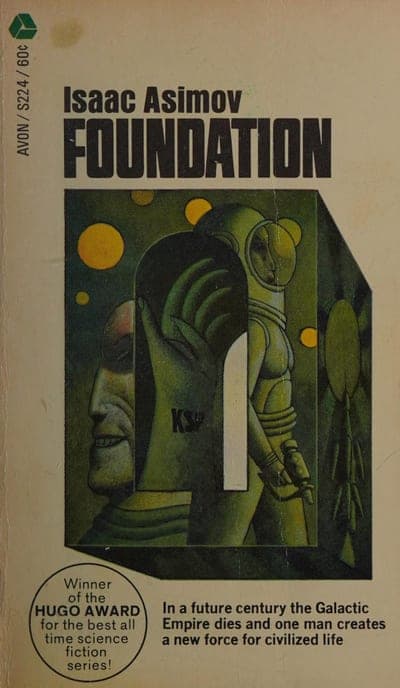
- First published
- 1951
- Author
- Isaac Asimov
- Publisher
- Gnome Press
- Pages
- 200
- This copy
- Avon Books paperback, 1966 (stock no. S224, 60-cent printing)
Foundation
Isaac Asimov · 1951
The Galactic Empire is falling and one man has the math to see it coming, centuries out: Hari Seldon, whose invented science can predict what an empire's worth of people will do even though it can't predict what any one of them will do. He says so publicly, is tried for it, and is sentenced to exile at the edge of the galaxy — exactly where he wanted to be sent.
The science is psychohistory, and Seldon uses it to found a colony on the planet Terminus, ostensibly to compile an Encyclopedia Galactica and actually to seed the nucleus of a second empire, cutting a coming thirty-thousand-year dark age down to one thousand. The book is a fix-up rather than a novel written straight through — four stories published in Astounding Magazine between 1942 and 1944, plus an opening section written new for the 1951 book — and the structure shows it: each section jumps decades ahead to a new crisis, starting with Seldon and moving on to Terminus's mayor, Salvor Hardin, who takes two of them in a row and talks his way out of a war with a threatening neighbor state on his own maxim that violence is what you resort to once you've run out of better options.
It's a book of committee rooms and political maneuvering more than a book of people — almost nobody in it gets much interior life, including Seldon, who mostly appears afterward as a recording delivering predictions that keep turning out right. Read it for the premise rather than for the people, and go in knowing you won't come out remembering anyone in it by name.