- First published
- 2021
- Author
- Oliver Burkeman
- Publisher
- Farrar, Straus and Giroux
- Pages
- 288
- This copy
- Farrar, Straus and Giroux, 2021
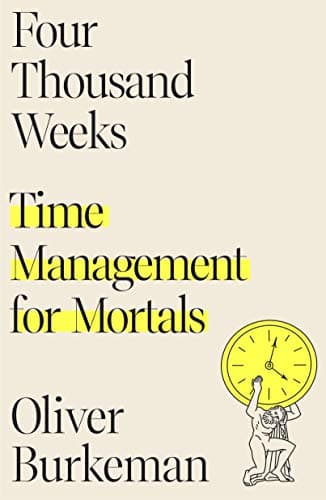
Four Thousand Weeks
Time Management for Mortals
Oliver Burkeman · 2021
Eighty years is about four thousand weeks. Burkeman puts the number down early and then argues that the entire literature of time management is a way of not looking at it, because every system on the shelf promises a day where everything fits and there is no such day. The premise is not that people are bad at productivity. It is that the goal itself — getting on top of it all — describes something that cannot exist.
His mechanism is the efficiency trap. Clearing an inbox faster teaches everyone to send more; getting quicker at the work makes more work arrive; convenience frees time that refills before it can be enjoyed. So the useful question stops being how to fit everything in and becomes what to neglect on purpose — his phrase for it is choosing to settle, and he treats missing out as the thing that makes a choice a choice. Along the way: Hofstadter's law, Kieran Setiya's atelic activities, pursuits whose whole point is the doing, so a hobby is allowed to stay bad, and cosmic insignificance therapy, the relief of accepting that a life need not matter cosmically.
It lands hardest for someone who has already run three systems and still feels behind, because it reframes that feeling as a category error rather than a personal failing. The reservation is that it is a book of arguments and not a method: the practical content is an appendix of ten tools at the back, and a reader who wants to know what to do on Monday morning will find that thin. Its consolations can also be read as permission to stop trying, which is not what Burkeman says but is easy to carry away.