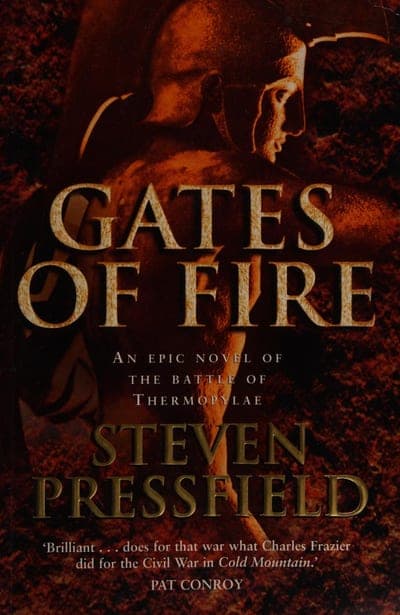
- First published
- 1998
- Author
- Steven Pressfield
- Publisher
- Doubleday
- This copy
- A paperback reprint, likely Bantam (exact printing not confirmed from the jacket)
Gates of Fire
Steven Pressfield · 1998
Xeones is found alive among the dead at Thermopylae, barely, and the Persian king Xerxes has him kept that way so he can tell the story of the men who held the pass — the account is being taken down by the king's own scribe, which is the frame the whole novel sits inside. Xeones isn't a Spartan citizen; he's a perioikos, a free non-citizen who trained alongside Spartan boys in their brutal upbringing and ends up serving as a squire in the battle itself.
The novel moves between his voice and the scribe recording it, and spends real time on how Spartan society actually produces the discipline it's known for — the agoge, the phalanx, the relationships among men like King Leonidas, the officer Dienekes, and the warrior Alexandros — before it ever gets to the pass itself. The 300 Spartans holding a chokepoint against a Persian army is the known shape of the story; the book's interest is in what built the men capable of doing it.
It's built and researched as historical fiction, not as the stylized action of the film 300, which took the same battle in a very different direction. Readers who want the military and social detail behind Thermopylae get it in depth; readers wanting something fast-moving from the start will find the setup takes its time.