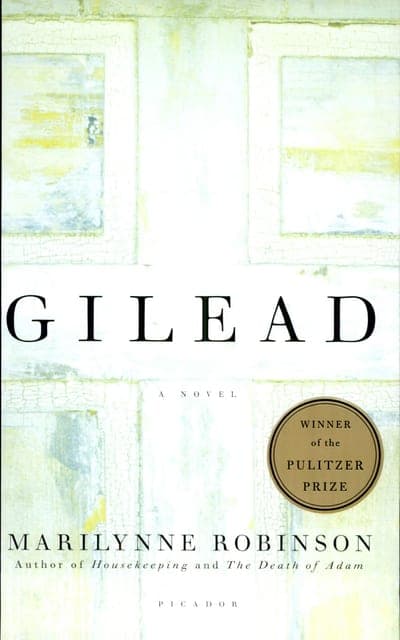
- First published
- 2004
- Author
- Marilynne Robinson
- Publisher
- Farrar, Straus and Giroux
- Pages
- 247
- This copy
- Farrar, Straus and Giroux, 2004
Gilead
Marilynne Robinson · 2004
An old preacher in a small Iowa town is dying, and he has a seven-year-old son who will not remember him. The whole book is the letter he writes for the boy to read as an adult — an account of his father and his grandfather, both preachers, who disagreed so violently about the Civil War that one of them walked out of the other's church.
Almost nothing happens. A godson comes home and the old man cannot bring himself to trust him, and that is most of the plot. What the book is actually doing is paying attention: to light on a wall, to water thrown by two young men playing, to the physical fact of a congregation. Robinson's argument is that this kind of noticing is a religious act, and she makes it by demonstration rather than by assertion.
It won the Pulitzer and it is a slow book, deliberately. The reward is a narrator who is genuinely good without being simple, and who knows his own faults precisely — a rarer thing on the page than it sounds. Readers who find nothing in it usually found the pace; readers who love it tend to reread it every few years.