- First published
- 2003
- Author
- Simon Winchester
- Publisher
- Harper Perennial
- This copy
- Harper Perennial 'P.S.' paperback edition
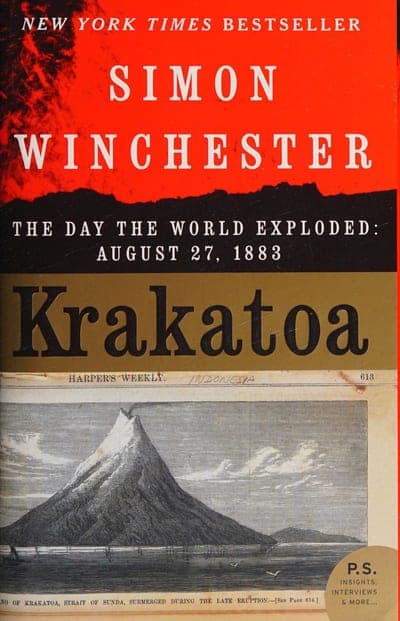
Krakatoa
The Day the World Exploded: August 27, 1883
Simon Winchester · 2003
Simon Winchester spends the first stretch of this book on geology before he ever reaches the eruption itself — plate tectonics, the volcanic history of the region — so that when Krakatoa actually goes in August 1883, the reader understands why it went the way it did. Most of the island collapsed into the sea, and the charts had to be redrawn. The eruption killed more than thirty-six thousand people; the official Dutch count was 36,417. The sound of it was heard in Perth, Western Australia, and on Rodrigues Island near Mauritius, three thousand miles off. Its effects reached around the planet: high dust reddened sunsets over Europe and America for months, vividly enough that fire engines were turned out in New York for a sky mistaken for a blaze, and the wave it threw off registered on tide gauges as far away as the English Channel.
Winchester, who worked as a geologist before he became a journalist, traces a harder, longer consequence past the immediate death toll: the disaster fed a wave of anti-Western violence in Muslim Indonesia that he connects to the eventual end of Dutch colonial rule there. It's the move that keeps the book from being only a disaster narrative — the eruption is the beginning of the story he wants to tell, not the whole of it.
It lands for readers who want the science made to actually matter to the narrative rather than sitting beside it, which is Winchester's particular skill — attaching a great many threads to a single event without losing the story itself. The honest reservation is scope: the political through-line from 1883 toward the end of Dutch rule is the part most likely to be read as more speculative than the geology, which is on much firmer ground.