- First published
- 2007
- Author
- Chip Heath and Dan Heath
- Publisher
- Random House
- Pages
- 304
- This copy
- Random House, 2007
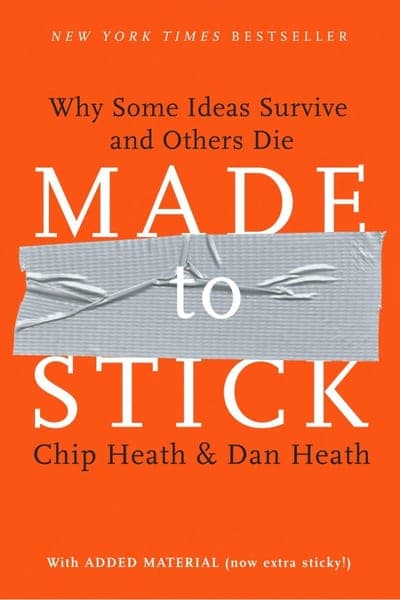
Made to Stick
Why Some Ideas Survive and Others Die
Chip Heath and Dan Heath · 2007
The book opens with the Kidney Heist — the urban legend about a man who wakes up in a hotel bathtub full of ice, missing a kidney — not because it's true but because everyone has heard some version of it. The Heaths use that fact as their argument: a ludicrous, false story keeps circulating with no resources behind it at all, while true and useful ideas struggle to be remembered for a week. Their question is why some ideas spread and most don't, and their answer has almost nothing to do with how important or accurate an idea is.
SUCCESs is their name for the six traits sticky ideas share — Simple, Unexpected, Concrete, Credible, Emotional, Stories — and each gets a chapter built around real cases. Southwest Airlines is the example for simplicity: 'the low-fare airline' as a single sentence clear enough that any employee can decide, unassisted, whether a new idea belongs at the company. For credibility, they use the scientist who drank the bacteria he believed caused stomach ulcers, proving it on himself rather than waiting for a trial to be believed.
It's a book about communication written by two brothers who make their living teaching and writing about business, and it's aimed squarely at people who write or pitch for a living — marketers, teachers, executives. The self-awareness is part of the pitch: a book about what makes ideas stick, built around an acronym designed to stick, occasionally reads like it's demonstrating its own trick a little too visibly.