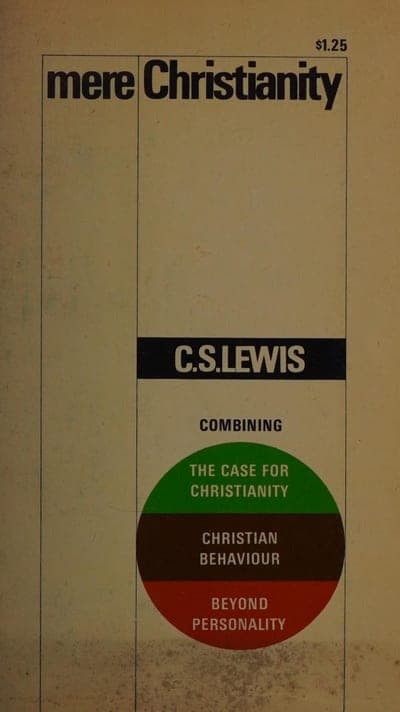
- First published
- 1952
- Author
- C.S. Lewis
- Publisher
- Macmillan
- This copy
- Macmillan paperback (US)
Mere Christianity
C.S. Lewis · 1952
The book began as short, timed radio talks on the BBC during the Second World War — mostly fifteen minutes, mostly live, though one series was cut to ten and by the last series a late slot forced him to pre-record some of them. The BBC held its timings hard, and Lewis wrote to that constraint, in spoken sentences meant to be heard once, so the book keeps the cadence of broadcasts he never fully rewrote.
The argument builds in stages, across what were originally three separate published volumes. Book One starts from an observation Lewis thinks nobody can escape: people quarrel by appealing to a standard both sides already accept, and even a government that rejects conventional morality still argues its enemies broke faith. He treats this common, unargued sense of fair play as evidence for something behind the universe. Book Two turns to Jesus and narrows the options to three: he was lying, he was deluded, or he was telling the truth about being God — the argument known outside the book as the trilemma. The later sections work through the four classical virtues and the three theological ones, ending on what Lewis calls becoming a different kind of person, not just believing different things.
It's built for someone who has never read theology and doesn't want to feel like they're starting one, which is why it still gets handed to people first. The trilemma is also the part apologetics students get warned about: it only works if the Gospels' account of what Jesus said about himself is accurate, and readers who don't grant that premise will find the middle section resting on it rather than proving it.