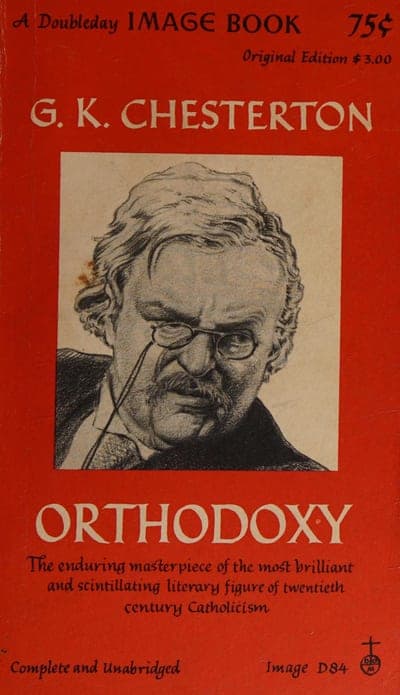
- First published
- 1908
- Author
- G.K. Chesterton
- Publisher
- Doubleday
- This copy
- Doubleday Image Books paperback, no. D84
Orthodoxy
G.K. Chesterton · 1908
Chesterton opens by imagining a story he once wanted to write: an English yachtsman slightly miscalculates his course, lands somewhere he doesn't recognize, plants a flag, and prepares to name his discovery — only to find out it's England. That's the shape of the whole book. He describes working out his own philosophy point by point, feeling proud of each discovery, and slowly realizing he had reconstructed, badly and from scratch, the historic Christian orthodoxy that had been sitting there the whole time.
The clearest working-out of the argument is the chapter called 'The Ethics of Elfland.' Chesterton takes fairy tales seriously as logic, not decoration — Cinderella as the principle that the humble get exalted, Beauty and the Beast as the claim that a thing must be loved before it becomes lovable — and draws from them a distinction science quietly erases. Two and one make three by necessity; it can't be pictured otherwise. An apple falling isn't necessary in that sense — it happens again and again without having to. He treats the gap between a law of logic and a repeated fact as the gap between a rule and a spell, and concludes the world behaves less like a machine running to specification and more like something given as a gift.
It rewards a reader who likes argument conducted through paradox and image rather than syllogism — Chesterton reaches for a fairy tale before a premise — and it asks real patience with sentences that turn back on themselves before they land. It isn't systematic theology and doesn't try to be; readers looking for the kind of sequenced case Lewis makes in Mere Christianity will find Orthodoxy circling its subject instead of marching through it.