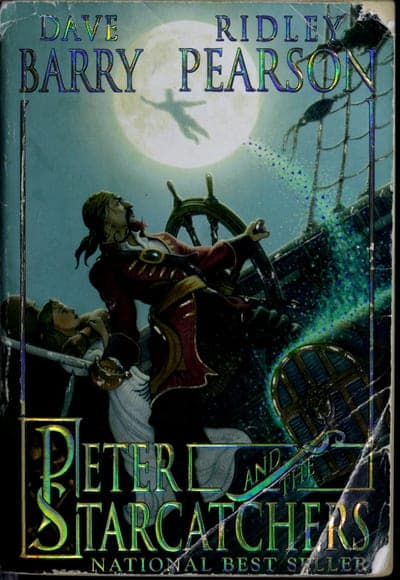
- First published
- 2004
- Author
- Dave Barry and Ridley Pearson
- Publisher
- Hyperion Books for Children
- Pages
- 452
- This copy
- Hyperion Books for Children, 2004
Peter and the Starcatchers
Dave Barry and Ridley Pearson · 2004
Five orphan boys — one of them a boy simply called Peter — are being shipped off across the ocean aboard a decrepit ship called the Never Land, which is also carrying a locked trunk nobody will explain to them. A second, identical trunk is crossing on a separate ship, the Wasp, and when the pirate Black Stache finally corners it, he finds it's packed with sand. The real cargo is on Peter's ship the whole time: something called starstuff, a substance that falls from the sky and does something different to whatever it touches.
Starstuff is what turns this into an origin story instead of a retelling. When it activates during a storm while Peter is helping a girl named Molly Aster get rid of the trunk, it's what leaves him able to fly and unable to age — the exact thing the original Peter Pan story never explains. The rest of the mythology arrives the same way: Molly's father turns an ordinary bird into what becomes Tinker Bell, Black Stache loses a hand to Peter in the final fight and it ends up in the jaws of a crocodile called Mister Grin, and the island itself — home to a tribe called the Mollusks, led by Fighting Prawn — doesn't even have a name until the very end, when Peter finds a plank and christens it Never Land.
This is a children's novel by Dave Barry and Ridley Pearson, not J.M. Barrie's original story and not the stage play built from the same material — it's a separate, later work that treats Barrie's familiar elements as puzzles to explain rather than scenery to reuse. It's built for readers who already know Peter Pan and want to watch each piece click into place, which makes it a stranger read for someone coming to the mythology cold.