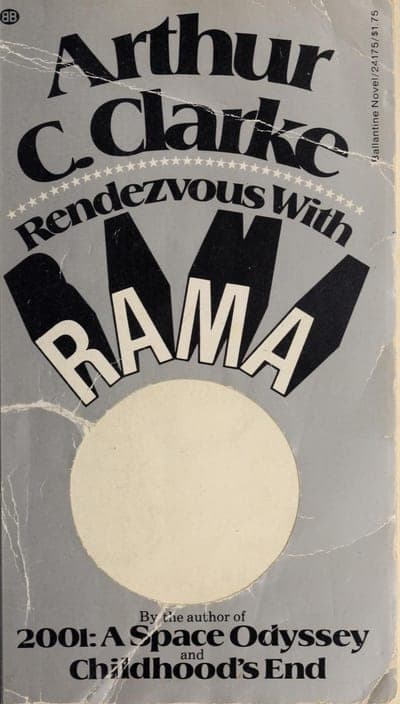
- First published
- 1973
- Author
- Arthur C. Clarke
- Publisher
- Ballantine Books
- Pages
- 276
- This copy
- Ballantine Books, 1974
Rendezvous with Rama
Arthur C. Clarke · 1973
In 2131 a fifty-kilometer cylinder enters the solar system on a trajectory too precise to be natural, and the crew of the survey ship Endeavour, under Commander Norton, gets to it first — the only ship anywhere near the right orbit to reach it before it's gone again.
Rama turns out to be a built world folded inside a shell: two plains running the length of the cylinder, a frozen band of water down the middle the crew names the Cylindrical Sea, an island of structures they call New York. Machines that are part biological — biots, crab-shaped and later spider-shaped, that come out to do maintenance and take apart anything left lying around — are the closest thing to a Raman anyone meets; no actual alien ever appears. The whole book is Norton's crew reading an enormous, functioning, silent machine and working out its purpose from what it does rather than from anyone explaining it.
There's no antagonist and, by design, barely a character — Norton is competent and reasonable and that's close to the whole of him, and the crew mostly exists to have discoveries happen to them. As Rama nears the sun it uses the star's energy to change course and leaves the solar system entirely, headed for the Large Magellanic Cloud, without explaining itself to anyone. That ending is either the most honest one available to a first-contact story, or the one thing about this book its own sequels spent three more novels trying to undo.