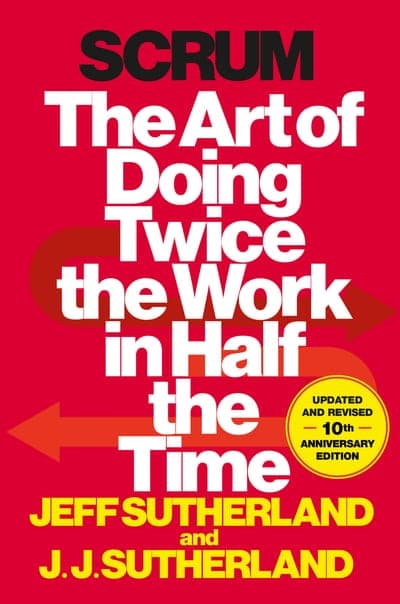
- First published
- 2014
- Author
- Jeff Sutherland
- Publisher
- Currency
- Pages
- 384
- This copy
- Currency — 10th anniversary edition, updated and revised
Scrum
The Art of Doing Twice the Work in Half the Time
Jeff Sutherland · 2014
The FBI's Sentinel project is the book's proof of concept: a system meant to make the Bureau's paper case files searchable, which had swallowed years and hundreds of millions of dollars under a conventional, sequential plan and still left agents unable to search their own case files. The Bureau brought the work in-house, cut the team from hundreds of contractors to under fifty, threw out the plan, and finished the remaining work in roughly twenty months running Scrum.
The name comes from a 1986 Harvard Business Review paper by Takeuchi and Nonaka comparing product development to a rugby scrum — the whole team carrying the ball down the field together instead of passing it station to station. Sutherland's account keeps returning to the tour he spent flying reconnaissance over North Vietnam, where the lesson was to respond to the situation in front of him rather than to the plan he left with; the working mechanics came much later, in 1993, at a software company called Easel. Those mechanics are the usable part: work sized in relative story points rather than hours, estimates made by planning poker so the loudest voice doesn't set the schedule, a daily stand-up capped at fifteen minutes, and capacity measured by what the team actually finished last sprint instead of what it promised.
It is written for the person running the team rather than sitting on one — a manager or founder deciding whether to tear up a project plan and try this instead. The honest reservation is that Sutherland is Scrum's co-inventor and its chief salesman, so every case in the book is a turnaround, and the failures it recounts are failures of the old way or of organisations that would not adopt Scrum.