- First published
- 1958
- Author
- Elisabeth Elliot
- Publisher
- Hodder and Stoughton
- This copy
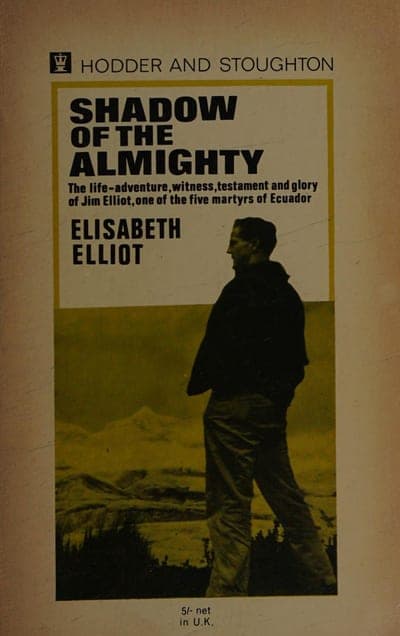
- Hodder and Stoughton paperback, UK (pre-decimal printing, per '5/- net in U.K.' price on jacket)
Shadow of the Almighty
The life-adventure, witness, testament and glory of Jim Elliot, one of the five martyrs of Ecuador
Elisabeth Elliot · 1958
Elisabeth Elliot wrote this in 1958, two years after five missionaries, her husband among them, were speared on a sandbar in the Curaray River in eastern Ecuador. The title comes from the first verse of Psalm 91. The life is assembled largely out of Jim Elliot's own writing — journals and letters quoted at length — with her narration doing the joining.
The line everyone knows sits here in its place: he is no fool who gives what he cannot keep to gain that which he cannot lose, written in his journal in 1949, and a reworking of a sentence of Philip Henry's from three centuries earlier. Around it is a plain account of a life that was short and deliberate. He is at Wheaton from 1945 to 1949. He goes to Ecuador and works among the Quichua. He marries Elisabeth Howard in Quito in 1953. She had already told the story of the mission itself in Through Gates of Splendor the year before, which frees this book to stay on him.
It lands for a reader who wants the shape of a life lived on a single conviction, and it is unusually well made for its kind, because most of it is not the biographer's prose. The reservation is that it is a widow's book about a man she believed in, written two years after he died, and it never steps outside him. The Waorani are present mainly as the people who killed him. Whether the mission was well judged is not a question it asks. It does not supply the other side, and does not try to.