- First published
- 2008
- Author
- John J. Ratey with Eric Hagerman
- Publisher
- Little, Brown and Company
- Pages
- 304
- This copy
- Little, Brown and Company, 2008
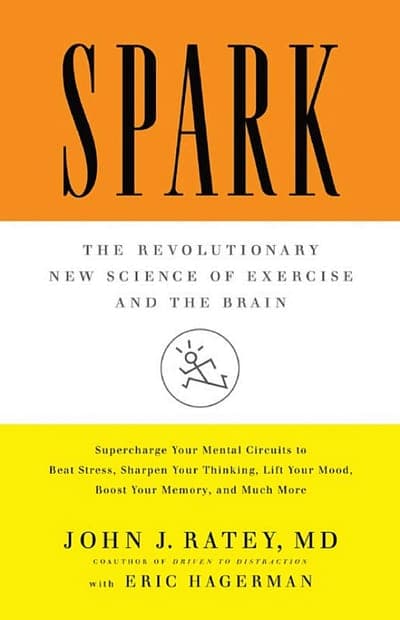
Spark
The Revolutionary New Science of Exercise and the Brain
John J. Ratey with Eric Hagerman · 2008
Every school day at 7:10 a.m., before their normal classes start, students at Naperville Central High School run a mile as hard as they can, tracked by heart-rate rather than by pace, in a program the school built around one idea: that exercise sharpens the brain the same way it sharpens the body. John Ratey opens with this program and returns to it throughout, because Naperville's standardized test scores rose enough after adopting it to draw national attention.
Ratey, a Harvard psychiatrist, builds the case chapter by chapter around a single mechanism: aerobic exercise triggers the release of brain-derived neurotrophic factor, a protein he calls 'Miracle-Gro for the brain' that helps neurons grow and form new connections. He walks that mechanism through specific conditions — a Duke study in which exercise matched antidepressant medication for treating depression and produced a lower relapse rate, the case for exercise easing anxiety and ADHD symptoms, and its protective effect against the cognitive decline of aging. The through-line in every chapter is the same: exercise doesn't just condition the body for more exercise, it conditions the brain for the next hour of thinking.
It's written for a general reader, not a clinician, and it's upfront that most of what it recommends is unglamorous — regular aerobic movement, nothing exotic — dressed up in a genuinely interesting explanation of why it works. The honest caveat is the book's age: it came out in 2008, and the exercise-and-brain research it leans on has kept moving since, so some of the specific studies it cites are no longer the newest word on the subject. The core argument — that exercise belongs in the treatment plan, not just the gym schedule — hasn't dated the same way.