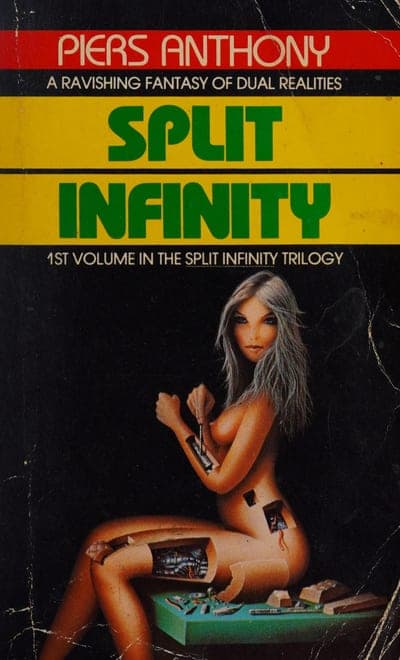
- First published
- 1980
- Author
- Piers Anthony
- Publisher
- Ballantine Books (Del Rey)
- This copy
- Paperback, marketed on the jacket as '1st volume in the Split Infinity trilogy' (the Apprentice Adept series later grew to seven books); no publisher mark is legible on this jacket
Split Infinity
Piers Anthony · 1980
Proton is a barren mining planet lived on under domes, its air long since destroyed by the mining, owned by Citizens and worked by serfs who own nothing and are required to go naked. Twenty years of service buys a serf retirement. Stile is a serf and a champion of the Game, the contest that is the planet's main pastime: two players choose from a grid, Physical, Mental, Chance and Arts crossed with Naked, Tool, Machine and Animal, and the cell they land on sets the category, which they then narrow on further grids until one actual contest is left. Then somebody tries to have him killed.
The second world is the trick. A curtain runs across Proton that only a few people can cross, and on the far side the same ground is green and magic works. Stile crosses into Phaze, is befriended by a unicorn called Neysa, and finds he has a legacy there as the Blue Adept, a magician whose spells are made of music and rhyme. The tune raises the power and the words point it. Anthony then alternates: one man, two sets of rules, with a robot named Sheen keeping him alive on the side where the rules are physics.
The Game holds up. The grid is a genuinely good invention and Anthony writes competition better than he writes anything else here. The nudity does not hold up; the book returns to it far more often than the premise requires, and the women are lit for the reader rather than written. It is also the opening of a series and behaves like one, setting out its two worlds thoroughly and finishing almost nothing.