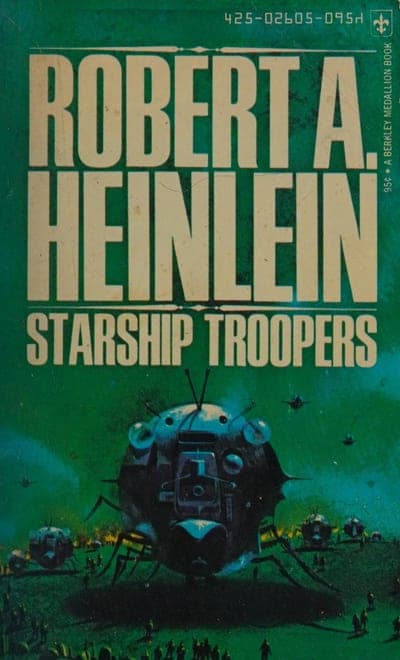
- First published
- 1959
- Author
- Robert A. Heinlein
- Publisher
- G. P. Putnam's Sons
- This copy
- Berkley Medallion paperback (mid-1970s printing)
Starship Troopers
Robert A. Heinlein · 1959
Juan "Johnny" Rico signs up for Federal Service on a whim, partly because a girl he likes, Carmen Ibañez, tells him she's enlisting too, and ends up in the one branch that puts him on the ground: the Mobile Infantry, dropped from orbit in a capsule and fighting in powered armor the book describes in more mechanical detail than it gives most of its characters.
The setup is a future where full citizenship — the vote, the right to hold office — is earned through a term of federal service rather than handed out at birth, and the book spends less time on the war against the Arachnids than on defending that arrangement. Rico's old high school teacher, Mr. Dubois, gets long stretches of the book to argue for it directly: that rights only mean something when people are willing to fight and die to keep them. Rico's mother dies when the Bugs destroy Buenos Aires, and the disastrous invasion of the Bug homeworld, Klendathu, comes after his training — though the book opens on an earlier raid against the Skinnies. It ends with Rico a second lieutenant, commanding his own old platoon — nicknamed Rico's Roughnecks — with his own father serving under him as platoon sergeant.
It reads like a training manual crossed with a philosophy seminar, which is the point and also the reservation: the plot mostly exists to serve the argument, and the argument — that violence backed by service is what makes citizenship legitimate — is why people are still arguing about this book more than sixty years later. The 1997 film plays as a satire of exactly that argument; the novel isn't written as one.