- First published
- 2022
- Author
- Carl R. Trueman
- Publisher
- Crossway
- This copy
- Crossway, 2022
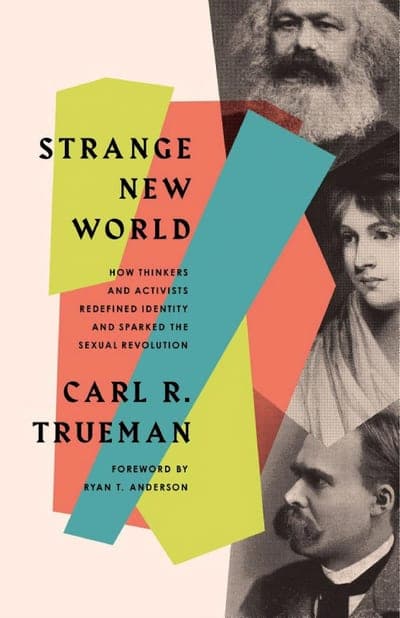
Strange New World
How Thinkers and Activists Redefined Identity and Sparked the Sexual Revolution
Carl R. Trueman · 2022
The book opens with a feeling rather than an argument: that the West has become a place where nothing behaves the way you expect, and where beliefs held as unquestioned orthodoxy the day before yesterday are now treated as heresies. Trueman's question is not whether the new beliefs are true. It is how they became intelligible — how claims that would have been incoherent to almost everyone a century ago now land as plain statements of fact. Nine chapters and roughly two hundred pages go to answering that.
The route runs through people, in order. Rousseau, who placed the authentic self inside the person and the corruption outside in society; the Romantics, who made feeling the test of what is true; then Marx, Nietzsche and Freud, and later Wilhelm Reich, Simone de Beauvoir and Germaine Greer. The shape is three moves: the self becomes psychological, the psychological self becomes sexual, and sex becomes political. Two borrowed terms carry the explanation of how ideas nobody has read end up governing ordinary intuitions — Charles Taylor's social imaginary, and expressive individualism for what the result feels like from inside.
This is the short version of Trueman's own 'The Rise and Triumph of the Modern Self', about two hundred pages against more than four hundred, with the argument compressed and the application moved forward. That cuts both ways. A reader of the longer book will find little here that is new. A reader who wants the evidence for a particular link in the chain will find it asserted rather than demonstrated. The short book states the chain; the long one argues it. As an intellectual genealogy it is clear and well ordered. As a causal account of why a whole culture moved, it has a chain of thinkers doing the work of a chain of causes.