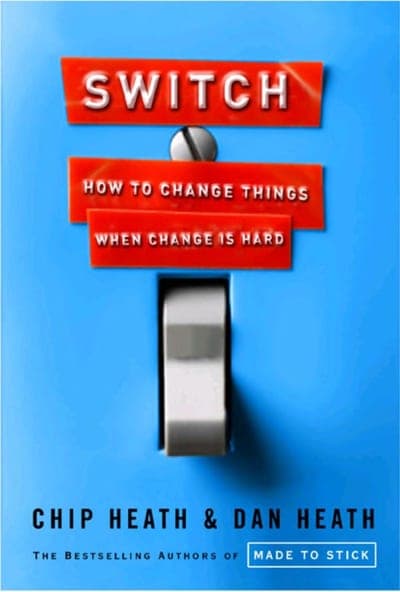
- First published
- 2010
- Author
- Chip Heath and Dan Heath
- Publisher
- Broadway Books
- Pages
- 320
- This copy
- Broadway Books, 2010
Switch
How to Change Things When Change Is Hard
Chip Heath and Dan Heath · 2010
The book opens at the movies, where Brian Wansink hands people five-day-old popcorn in two sizes of bucket and the bigger-bucket group eats 53 percent more. Nobody believes the bucket did it. That is the Heaths' opening move: what looks like a person problem is usually a situation problem. The three-part frame arrives later in the same chapter — a rational Rider on top of an emotional Elephant, both moving along a Path that can be made easier or harder to walk.
Chapter two goes to Vietnam, where Jerry Sternin has six months, almost no money and a brief from Save the Children on child malnutrition. Instead of surveying what is wrong he hunts the exceptions — families no better off than their neighbours whose children are healthy anyway — and finds mothers adding tiny shrimp and crabs from the rice paddies, food adults ate but nobody thought fit for children, plus sweet-potato greens considered low-class, and spreading the same quantity across four small meals instead of two. For moving the Elephant rather than instructing the Rider, the example is Jon Stegner, who could not get his company to look at what it wasted on supplies until he piled one of each of its 424 different work gloves, price-tagged, on the boardroom table.
It is for someone with a specific stalled change in front of them, not for general self-improvement. The honest reservation follows any book built on paradigm cases: Sternin and the glove pile are dramatic, clean and short, and the three levers are far easier to state than to run. Knowing the Elephant has to feel something does not tell anyone what the feeling is in their own stuck project, or where their 424 gloves are.