- First published
- 2013
- Author
- Brian P. Moran and Michael Lennington
- Publisher
- Wiley
- Pages
- 218
- This copy
- Wiley, 2013
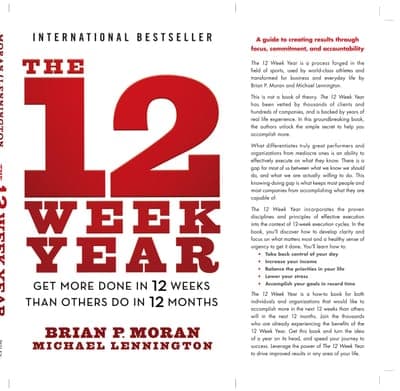
The 12 Week Year
Get More Done in 12 Weeks Than Others Do in 12 Months
Brian P. Moran and Michael Lennington · 2013
Moran and Lennington's argument starts with a specific failure mode: annual goals don't create urgency until the last few weeks of the year, because a year is long enough to feel like there's always more time — right up until there isn't. Their fix is to stop planning in years at all and run twelve-week cycles instead, each one treated with the seriousness most people reserve for December.
The mechanism is a weekly scorecard built on two kinds of measurement: lag indicators, the outcome you're after, and lead indicators, the specific actions that actually drive it — the difference between tracking weight lost and tracking miles run. The book's argument is that the weekly score to watch is how much of your planned action you actually executed, not how the outcome number happens to be moving at any given moment.
It comes out of a management-consulting practice built to sell this exact system to companies, and the prose has that register — plainspoken, repetitive, built for a workbook rather than a read-through. The idea underneath, that a shorter horizon with real weekly accountability beats a longer one with none, doesn't need the packaging to be true.