- First published
- 1945
- Author
- C.S. Lewis
- Publisher
- Macmillan
- Pages
- 133
- This copy
- Macmillan, 1946
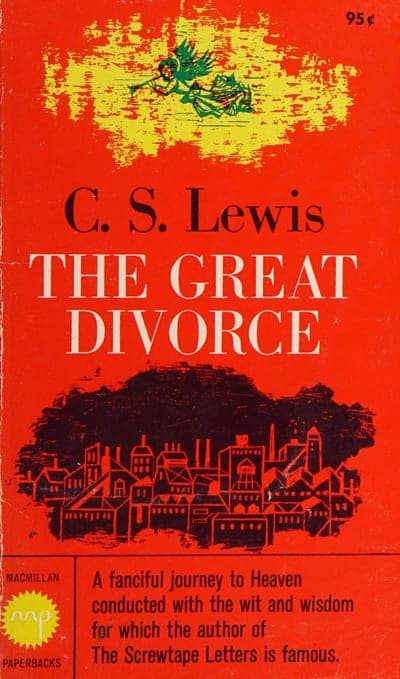
The Great Divorce
C.S. Lewis · 1945
A man waits at a bus stop in a grey town where it is always just about to rain and nobody can stand to live near anyone else. The bus goes to the outskirts of heaven. The passengers get out and find the grass too solid to walk on — they are ghosts, and the country is more real than they are — and each is met by someone who knew them, and asked to stay.
Almost all of them refuse, and the refusals are the book. One cannot let go of a grievance. One will not go in unless his own terms are met. One is so consumed by grief for her son that she has stopped being able to see anyone else, including him. Lewis's claim is that damnation is a door locked from the inside, and he argues it by dramatising the exact moment somebody chooses the smaller thing.
It is short, and it is a dream vision rather than doctrine — he says so in the preface, twice, because he expected to be read as speculating about the afterlife. What survives whether or not you share his theology is the psychology: the study of how a complaint hardens into an identity, and how much a person will give up rather than admit they were wrong.