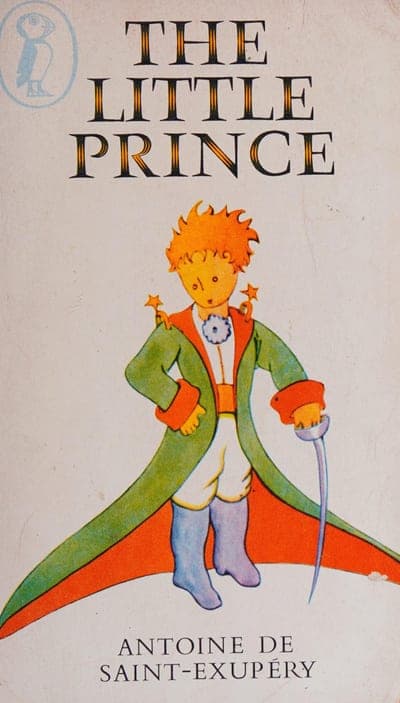
- First published
- 1943
- Author
- Antoine de Saint-Exupéry
- Publisher
- Reynal & Hitchcock
- This copy
- Puffin Books paperback (UK)
The Little Prince
Antoine de Saint-Exupéry · 1943
A pilot, telling the story afterward, crashes his plane in the Sahara and is trying to fix it before his water runs out when a small boy appears out of nowhere and asks him to draw a sheep.
The boy is a prince from a tiny asteroid, B-612, home to three volcanoes and a rose he loved and left, having come to feel she was working on him — she exaggerated her ailments and coughed to be fussed over — and he says later that he was too young to know how to love her. On his way to Earth he stops at six other tiny planets — a king with no subjects, a vain man who wants only applause, a drunkard drinking to forget he drinks, a businessman counting stars he thinks he owns, a lamplighter obeying orders on a planet that turns once a minute, a geographer who has never once left his desk to see anything he records. On Earth, a fox asks the prince to tame him and explains what that means: that time spent on a particular thing is what makes it irreplaceable, and that's why the prince's rose matters more than every other rose in the world.
It's a philosophical book wearing a children's book's clothes, and it's for readers who want that combination rather than a plot with more incident in it. The honest reservation is the ending, which the book does not soften: a snake bites the prince at his own request, on the theory that his body is too heavy to carry home, and he falls, and in the morning he's gone.