- First published
- 1692
- Author
- Brother Lawrence
- Publisher
- compiled by Joseph de Beaufort; first published by Edme Couterot (Paris)
- This copy
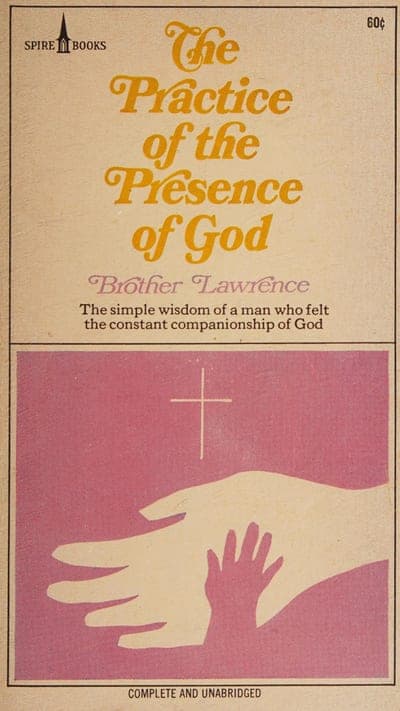
- Spire Books paperback (Fleming H. Revell imprint), 60-cent cover price — no printing year is legible on the jacket
The Practice of the Presence of God
Brother Lawrence · 1692
Nicolas Herman comes out of the Thirty Years' War lame from a wound taken at Rambervillers in 1635, works as a footman, and describes himself as a great awkward fellow who broke everything. In 1640, at twenty-six, he enters the Discalced Carmelite priory in Paris as a lay brother, takes the name Lawrence of the Resurrection, and is put in the kitchen. He cooks there for fifteen years, for a community that grows past a hundred, at a job he admits he had a natural aversion to. Afterwards he repairs sandals.
He did not write this book. Joseph de Beaufort, an official of the Archbishop of Paris, came to see him, kept notes on four conversations, and after Lawrence died in 1691 his letters were collected. The book that resulted is short: some conversations, some letters, and a handful of maxims, assembled by someone else. What survives through that secondhand channel is a single practice, stated again and again in slightly different words: keep company with God continuously inside ordinary work, so that the hour of cooking is not different in kind from the hour of prayer. He is candid about how long it took him before that settled.
It is very short and it repeats. There is no system, no argument developed across chapters, nothing that builds — the same instruction returns again and again, which is both the method and the limit. The other honest caution is what the book physically is. It is an edited record assembled by someone else, the conversations filtered through a listener's notes and a later editor's hand. Anyone wanting Brother Lawrence's own considered theology has only what he wrote down himself, and that is very little.