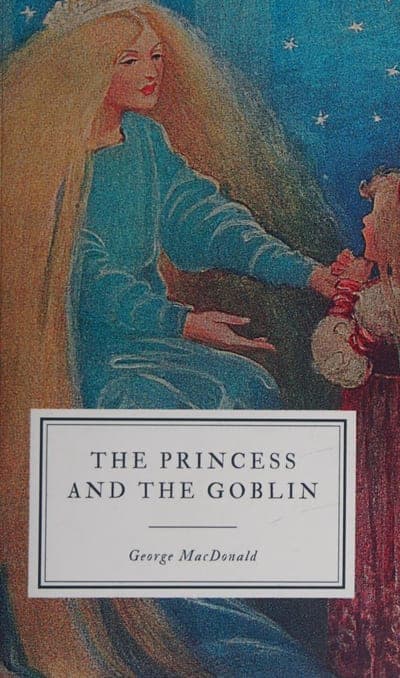
- First published
- 1872
- Author
- George MacDonald
- Publisher
- Strahan & Co.
- This copy
- A modern illustrated reprint (publisher and year not stated on the jacket)
The Princess and the Goblin
George MacDonald · 1872
Eight-year-old Princess Irene lives in a large house on a mountain with a nursemaid, Lootie, and a father who is mostly elsewhere. On a wet afternoon she climbs a stair she has never noticed before and finds an old woman spinning in a room at the top, who tells her she is her great-great-grandmother. Under the same mountain, in the mine tunnels, live the goblins, descendants of people driven underground long ago who have not forgiven it.
The goblins have a plan: flood the mine, tunnel up beneath the palace, carry off the princess and marry her to Prince Harelip, the goblin queen's son. Curdie, a miner's boy working nights, hears it through the rock, and also works out the one reliable fact about goblins. Their feet are soft, and stamping on them settles most arguments. The queen wears stone shoes. What MacDonald actually cares about is the other half of the book: the grandmother gives Irene a ring with a thread only she can feel, and when Irene follows it in an emergency it runs the wrong way, into the mountain rather than home. Curdie, who cannot see the grandmother at all, has to go on the girl's word.
It is a children's book that does not soften its terms. Irene is asked to keep faith with something she cannot demonstrate to anybody, and the book lets Curdie be sensible and wrong about it for a long while. The goblin material is broad comedy by comparison, and the narrator breaks in constantly to explain himself to the child reading, a Victorian habit that dates the book more than anything in the plot does.