- First published
- 2008
- Author
- Timothy J. Keller
- Publisher
- Hodder & Stoughton
- This copy
- Hodder & Stoughton UK edition
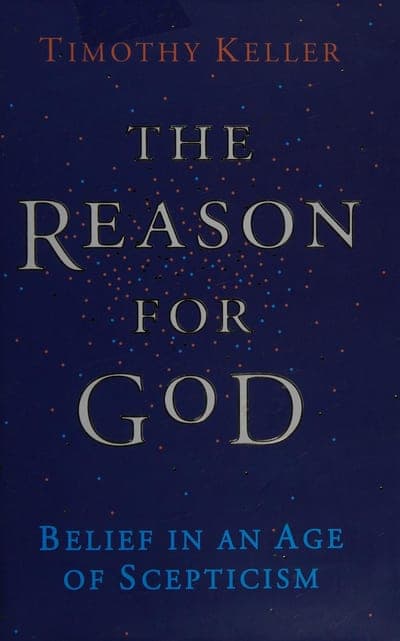
The Reason for God
Belief in an Age of Scepticism
Timothy J. Keller · 2008
The objections came out of the congregation — the ones Keller heard most often from skeptical New Yorkers over years of ministry. Part one gives seven of them a chapter each, titled in the skeptic's words rather than the pastor's: there can't be just one true religion; how could a good God allow suffering; Christianity is a straitjacket; the church is responsible for so much injustice; how can a loving God send people to hell; science has disproved Christianity; you can't take the Bible literally.
The hinge is a chapter called 'Intermission', and the two halves depend on it. Keller states there that he is not going to prove Christianity beyond doubt, and sets out the standard he will use instead — a critical rationality that asks which account makes better sense of what people already believe about justice, meaning and love. Part two then stops answering and starts building: the clues of God, the problem of sin, the difference between religion and the gospel, the cross, the resurrection, and a last chapter on the Trinity called 'The Dance of God'.
The compression is the reservation. Suffering gets a chapter. Hell gets a chapter. Anyone who has read seriously in this territory will find the arguments handled fast and will notice where the harder version of an objection was left out. What the book contributes is arrangement and temperature rather than new ground — it states each objection at something close to full strength before answering it, which is rarer than it ought to be. It is also written for a particular reader: educated, secular, urban, arguing in good faith. Readers outside that description will feel the room they are not in.