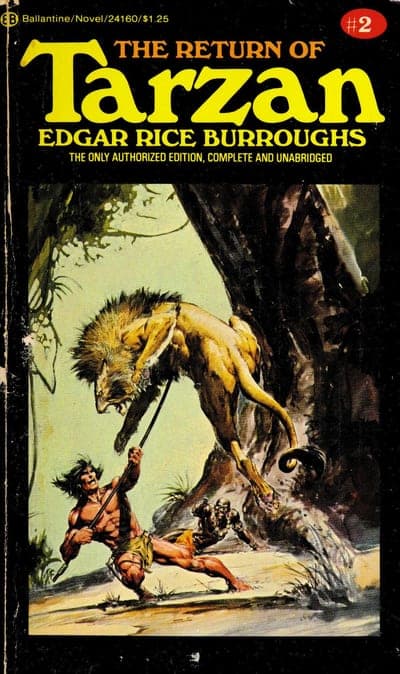
- First published
- 1913
- Author
- Edgar Rice Burroughs
- Publisher
- A. C. McClurg
- This copy
- Ballantine Books paperback (numbered series #2, catalog no. 24160, $1.25)
The Return of Tarzan
Edgar Rice Burroughs · 1913
This is the second Tarzan novel, and it opens with the ape-man having already given Jane up to another man and left for Europe, which makes it a different kind of story from the start. In Paris, Tarzan is framed as the lover of a countess by her own brother, fights a duel over it, and wins the husband's trust by handing him a loaded pistol and refusing to defend himself.
From there the plot keeps moving him: French intelligence work in Algeria, being thrown overboard mid-ocean by the same man who framed him in Paris, and a landing back on the exact stretch of African coast where he grew up. He's adopted into the Waziri tribe and elected their chief after driving off the ivory raiders who killed the old one, then leads them to the lost city of Opar, where the high priestess La — who speaks the ape-language he learned as a child — falls for him, and is left weeping on the temple floor when he comes back for Jane instead. Jane herself washes up on that same coast after a shipwreck of her own; her fiancé turns his back and covers his face rather than fight the lion stalking them, and Tarzan kills it with a thrown spear without revealing himself.
By the end, Tarzan and Jane marry in his father's cabin, in a double ceremony with a second couple, and the proof that he is the real Lord Greystoke comes back to him from the hand of the dying cousin who had been concealing it — a title Tarzan had already given up on purpose. It's a pulp adventure novel from 1913, built for momentum rather than restraint — coincidences pile up freely, and the same villain from the Paris chapters turns up again in Africa purely because the plot needs him to. Readers expecting the tighter Tarzan of later entries should know this one reads more like serialized adventure fiction than a novel with one throughline.