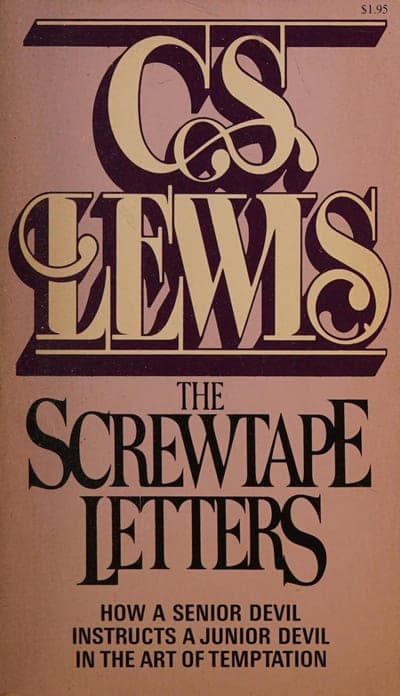
- First published
- 1942
- Author
- C.S. Lewis
- Publisher
- Geoffrey Bles
- This copy
- A Macmillan mass-market paperback ($1.95 cover price) — Macmillan published the US paperback line for this title across the 1940s-60s; the exact printing year is not stated on the cover and could not be pinned down further.
The Screwtape Letters
C.S. Lewis · 1942
The book is thirty-one letters, all going one direction: from Screwtape, a senior and comfortably established devil, to his nephew Wormwood, a novice tempter assigned his first human soul. There's no other narration. Screwtape never meets the man he's trying to destroy — called only 'the Patient' throughout — he coaches Wormwood entirely by mail, and the reader has to reconstruct the Patient's actual life, his conversion, his romance, his death in an air raid, from one demon's complaints and corrections to another.
The device holds up because Screwtape's Hell runs on the same bureaucratic self-interest as any large organization, and its theology is just human sin inverted and stated outright: devils want people the way a farmer wants cattle, God wants them the way a father wants sons. Screwtape's actual advice is the substance of the book — keep the Patient off any strong feeling, good or bad, and steer him instead toward the gradual, undramatic accumulation of habit; keep him thinking about the future instead of the present, where he's harder to manage. None of it arrives as doctrine. It arrives as tactics, from the losing side.
It lands best for readers who already find pious writing dull, since the whole device turns self-examination into something funny instead of solemn, watched from the tempter's side of the failure rather than delivered as a lecture. The place it can wear thin is the density: thirty-one short chapters running the same rhetorical move, a devil arguing for the opposite of what's actually true, and read straight through rather than a letter at a time, it can start to feel like one bit repeated rather than developed.