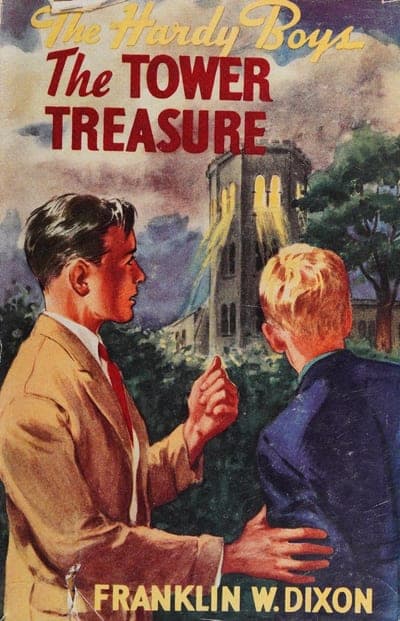
- First published
- 1927
- Author
- Franklin W. Dixon
- Publisher
- Grosset & Dunlap
- Pages
- 214
- This copy
- Grosset & Dunlap, original (pre-1959) text edition
The Tower Treasure
Franklin W. Dixon · 1927
Frank and Joe Hardy nearly run their car into a reckless driver who turns out, a page later, to have robbed the local ferry office and stolen their friend Chet Morton's car. That's the small case. The one that actually drives the book is bigger: someone has stolen forty thousand dollars in securities and jewels from Tower Mansion, and the owner, Hurd Applegate, is accusing the caretaker — father of the Hardys' friend Perry — on nothing more than the fact that the man recently paid off a debt he won't explain.
The two cases turn out to be one. The Hardys trace a red wig dropped by the reckless driver back to a New York criminal, and it's their father, detective Fenton Hardy, who runs the man down after a railroad accident — the man confesses on what he believes is his deathbed and mentions the loot is hidden "in the old tower." The boys find it in an abandoned railroad water tower, get briefly locked inside by a hobo living there, and clear Perry's father's name.
This is the book the whole Hardy Boys franchise starts from, first published in 1927 and credited, like all of them, to the house name "Franklin W. Dixon" — the actual writer was a Canadian journalist named Leslie McFarlane. The version on shelves now isn't quite that one: it was heavily rewritten in 1959, tightened and modernized, so what you're reading is a revision more than an original text. It's a boys'-adventure mystery from an earlier, simpler era of the genre, solved mostly through lucky timing rather than deduction, and it reads exactly that plainly.