- First published
- 2007
- Author
- Allan C. Carlson
- Publisher
- ISI Books
- Pages
- 225
- This copy
- ISI Books, 2007
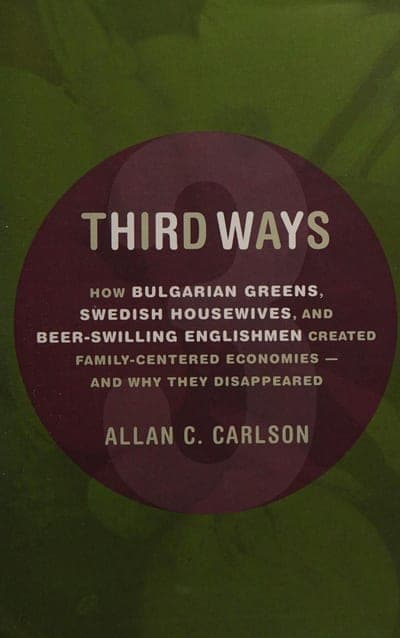
Third Ways
How Bulgarian Greens, Swedish Housewives, and Beer-Swilling Englishmen Created Family-Centered Economies — and Why They Disappeared
Allan C. Carlson · 2007
The first chapter is called "Chesterbelloc and the Fairy Tale of Distributism" — Shaw's nickname for Chesterton and Belloc, and Carlson's verdict on what the two of them built. Six more studies follow the same pattern. Each takes a twentieth-century movement that tried to organise economic life around the household rather than around the firm or the state, sets out what it actually proposed, and accounts for its disappearance.
The subjects have almost nothing in common but the shape of the idea. Peasant parties took power across Eastern Europe after the First World War — Carlson calls it the green rising — and did not survive what came after. The Russian economist Alexander Chayanov worked out a theory in which a farm household's output is set by what its own members need and are willing to do, not by wages or profit, and then wrote a utopia to go with it. There is a chapter on the last march of the Swedish socialist housewives, one on Karl Polanyi's economy without markets, one on the secular family wage, and one on the Christian democratic parties of postwar Europe.
It suits a reader already suspicious of the choice between market and state and willing to take history rather than manifesto. The honest reservation is that Carlson is not a neutral party — his career was in family-policy advocacy, and the sympathy runs one direction throughout. The seven cases also stay seven cases: separate historical studies rather than a cumulative argument, closing with a chapter titled "Dreams, Realities, Illusions." Anyone reading for what to do next finishes with a reading list instead.